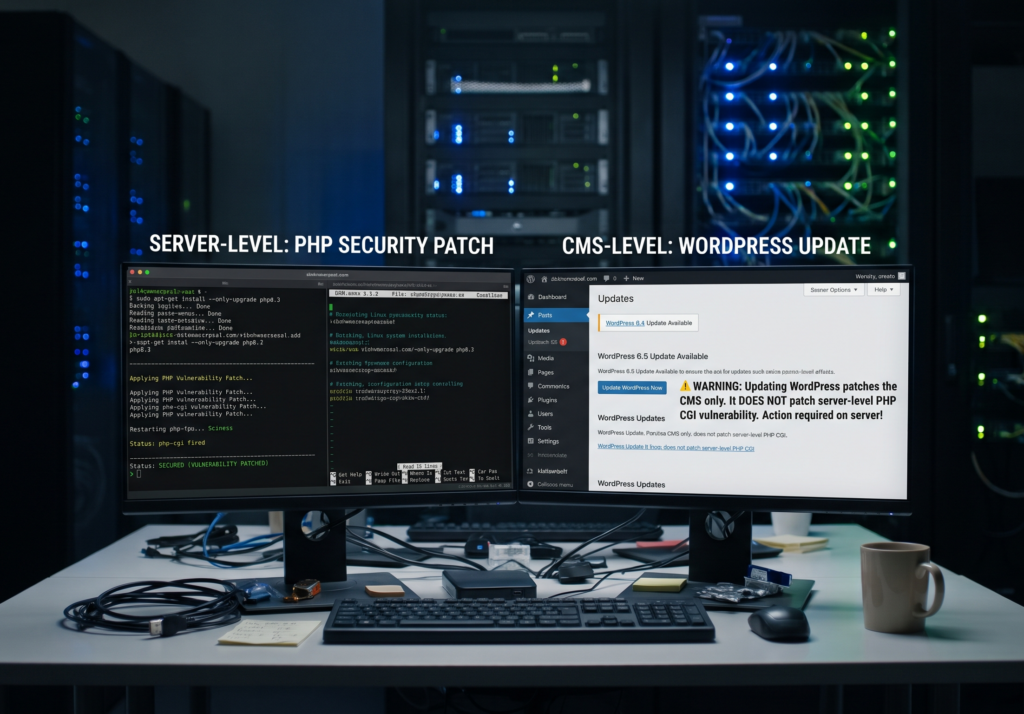
PHP Security Patch vs WordPress Update: What Actually Fixes the Vulnerability?
A PHP security patch and a WordPress update fix different parts of your website. A WordPress update addresses issues in WordPress core, while a PHP security patch fixes vulnerabilities in the PHP runtime running on your server. If your website is exposed to a PHP vulnerability such as PHP2Shell, updating WordPress alone will not fix it. You need to confirm that the affected PHP installation has received the appropriate security update.
What Is the Difference Between a PHP Security Patch and a WordPress Update?
A PHP security patch updates the server-side PHP software to fix a vulnerability. A WordPress update changes the WordPress application, including its core files, features, maintenance improvements and security fixes.
Although WordPress relies on PHP to run, the two are maintained separately. Updating WordPress does not automatically update the PHP version configured by your hosting provider.
| Maintenance task | What it fixes | Where the update is applied |
| PHP security patch | Vulnerabilities in the PHP runtime | Server or hosting environment |
| WordPress core update | Security and maintenance issues in WordPress | WordPress application |
| Plugin update | Issues in individual plugins | Installed WordPress plugins |
| Theme update | Issues in the active or installed themes | WordPress themes |
| Server configuration review | Relevant configuration and access-control weaknesses | Server or hosting environment |
For a secure website, these tasks should be treated as complementary rather than interchangeable.
Why Does a PHP Security Patch Matter?
PHP processes requests and executes application code on the server. WordPress, along with many other content management systems and web applications, depends on it.
A vulnerability in PHP can therefore affect a website even when its WordPress core, plugins and themes are up to date.
For example, PHP2Shell refers to CVE-2026-109618 and CVE-2026-109619. The PHP project released fixed versions on 21 October 2026. These vulnerabilities can allow unauthenticated remote code execution on affected PHP installations.
The fixed releases for these two vulnerabilities are:
| PHP branch | Fixed release |
| PHP 8.5 | 8.5.12 |
| PHP 8.4 | 8.4.27 |
| PHP 8.3 | 8.3.36 |
| PHP 8.2 | 8.2.35 |
These versions address the two PHP2Shell vulnerabilities, not every possible PHP security issue. Some hosting and operating system vendors also provide backported fixes, so administrators should confirm the patch status of their specific installation.
You can check the official PHP security advisories for the latest release information.
Does Updating WordPress Make Your Website Secure?
Updating WordPress is an essential security task, but it does not guarantee that every part of your website is protected.
WordPress updates can fix vulnerabilities in WordPress core. Plugin and theme updates address issues in those components. However, these updates do not necessarily change the PHP runtime managed by your hosting provider.
A website can therefore have the latest WordPress version and still run a vulnerable PHP installation.
The reverse is also true. Patching PHP does not automatically fix an outdated WordPress installation, a vulnerable plugin or an insecure theme.
The right approach is to maintain every relevant layer of your website. Apply the update that addresses the specific vulnerability rather than assuming that one general update resolves everything.
How Can You Check Whether Your PHP Runtime Is Updated?
If you use WordPress, start by identifying the PHP version serving your website.
1. Check the PHP version in WordPress
Log in to your WordPress dashboard and open Tools → Site Health → Info → Server. Depending on your configuration, the server section may show the PHP version.
This helps you identify the runtime, but the displayed version alone may not confirm whether a vendor-specific security patch has been applied.
2. Check your hosting dashboard
Look for PHP settings in your hosting control panel. Depending on your provider, this may be called PHP Selector, MultiPHP Manager or PHP Configuration.
Confirm which PHP version is assigned to your domain. If you host multiple websites or use separate application environments, check each relevant installation.
3. Ask your hosting provider to verify the patch
If you cannot establish the patch status, ask your provider to confirm:
- Which PHP runtime serves your website.
- Whether the security patch for the specific vulnerability has been applied.
- Whether vendor-provided or backported security fixes are being used.
- Whether other PHP installations, containers or scheduled scripts also require updates.
Should You Update WordPress or PHP First?
The answer depends on the vulnerability and the condition of your website.
If a critical PHP vulnerability affects your server, prioritise the appropriate security fix and follow your hosting provider’s remediation guidance. Do not assume that updating WordPress will address the underlying PHP issue.
Before making a planned PHP version upgrade, check compatibility with your WordPress version, plugins, theme and custom code. Create a verified backup and test the change in a staging environment where possible.
If a critical vulnerability is involved, compatibility testing should support timely remediation rather than become a reason to leave an exposed server unaddressed.
After updating PHP, test important website functions such as logins, forms, checkout pages and other business-critical features. Continue updating WordPress core, plugins and themes separately.
What If Your Website Was Exposed Before the PHP Patch?
Installing a security patch fixes the vulnerability covered by that update. It does not prove that an attacker never accessed the server before the fix was applied.
If your PHP installation was exposed, consider whether further investigation is needed. Warning signs can include unfamiliar administrator accounts, unexpected file changes, suspicious processes, spam pages or unexplained redirects.
These signs do not automatically prove a compromise, but they should be investigated.
Ask your hosting provider or a qualified security professional to review relevant logs and files if you suspect unauthorised access. Depending on the findings, you may need to remove malicious files, secure accounts or restore the system from a trusted backup.
Patching and incident investigation are separate tasks. A website may need both.
Who Should Handle PHP Security Updates?
On shared hosting, the provider generally manages the server’s PHP runtime. Contact the provider if you do not have permission to update it yourself.
On a VPS, dedicated server or cloud environment, responsibility may sit with your administrator, development team or managed hosting provider, depending on how the environment is configured.
Professional assistance may be useful if you cannot verify the patch status, the server runs multiple PHP installations, compatibility problems prevent an upgrade, or you suspect a compromise.
A service provider should clearly explain whether the work includes patching, verification, application testing and any separate investigation needed for a potentially compromised server.
For businesses seeking help with PHP security remediation, Alohomora Solution’s PHP vulnerability fixing service is one option to review. Check the service scope and confirm that it covers your hosting environment and specific security requirements before proceeding.
Final Thoughts
A PHP security patch and a WordPress update serve different purposes. Updating WordPress helps protect the application, while patching PHP addresses vulnerabilities in the runtime beneath it.
If your website is affected by a PHP security issue, identify the active runtime, confirm that the correct fix has been applied and check other relevant installations. Keep WordPress core, plugins and themes updated as separate tasks.
If the server was exposed before patching or shows signs of suspicious activity, consider a separate security investigation. Keeping each layer maintained helps you manage website security more effectively.
Frequently Asked Questions
1. Does a WordPress update include PHP security patches?
No. WordPress updates and PHP runtime updates are separate. Your hosting provider or server administrator must ensure the PHP installation receives the relevant security fix.
2. Can my WordPress website be vulnerable if everything is updated?
Yes. WordPress core, plugins and themes can be up to date while the server still runs a vulnerable PHP installation or has another security weakness.
3. How do I know whether my PHP security patch is installed?
Check the PHP version and ask your hosting provider or administrator to confirm that the relevant security fix is present. Vendor-provided backports may not be obvious from the displayed version number alone.
4. Should I update PHP before updating WordPress?
There is no universal order for every situation. If a critical PHP vulnerability affects your server, prioritise the appropriate security remediation. For planned version upgrades, check application compatibility and prepare a backup and testing plan.
5. Does patching PHP remove malware from my website?
No. A PHP security patch fixes the vulnerability it covers, but it does not automatically remove malicious files or reverse changes made by an attacker. A separate investigation may be required.